


For people whose insoles haven't fixed it.
The Mobility Base
The Mobility Base
It's not your arch.
It's the muscles holding it up.
Complete Your Protocol - Bundle & Save

Aurayae Axis
Couldn't load pickup availability


"Six pairs of insoles across four years. Three weeks in on the Axis I noticed I wasn't dreading my first morning step. Six weeks in I'd stopped wearing my heel cups. I'm 49."

The Mobility Base
A firm, single-leg balance board built around one idea: strengthening the small foot muscles that hold your arch up - the ones every insole, supportive shoe, and orthotic has been doing the job for. Four minutes per foot, per day. Watching TV is fine.
add shipping info
Included:
The Axis board
Adjustable Peg Base Bars
The Foot Strengthening Field Guide (free)
- American express payment method
- Apple pay payment method
- Bancontact payment method
- Diners club payment method
- Discover payment method
- Google pay payment method
- Maestro payment method
- Master payment method
- Shopify pay payment method
- Unionpay payment method
- Visa payment method


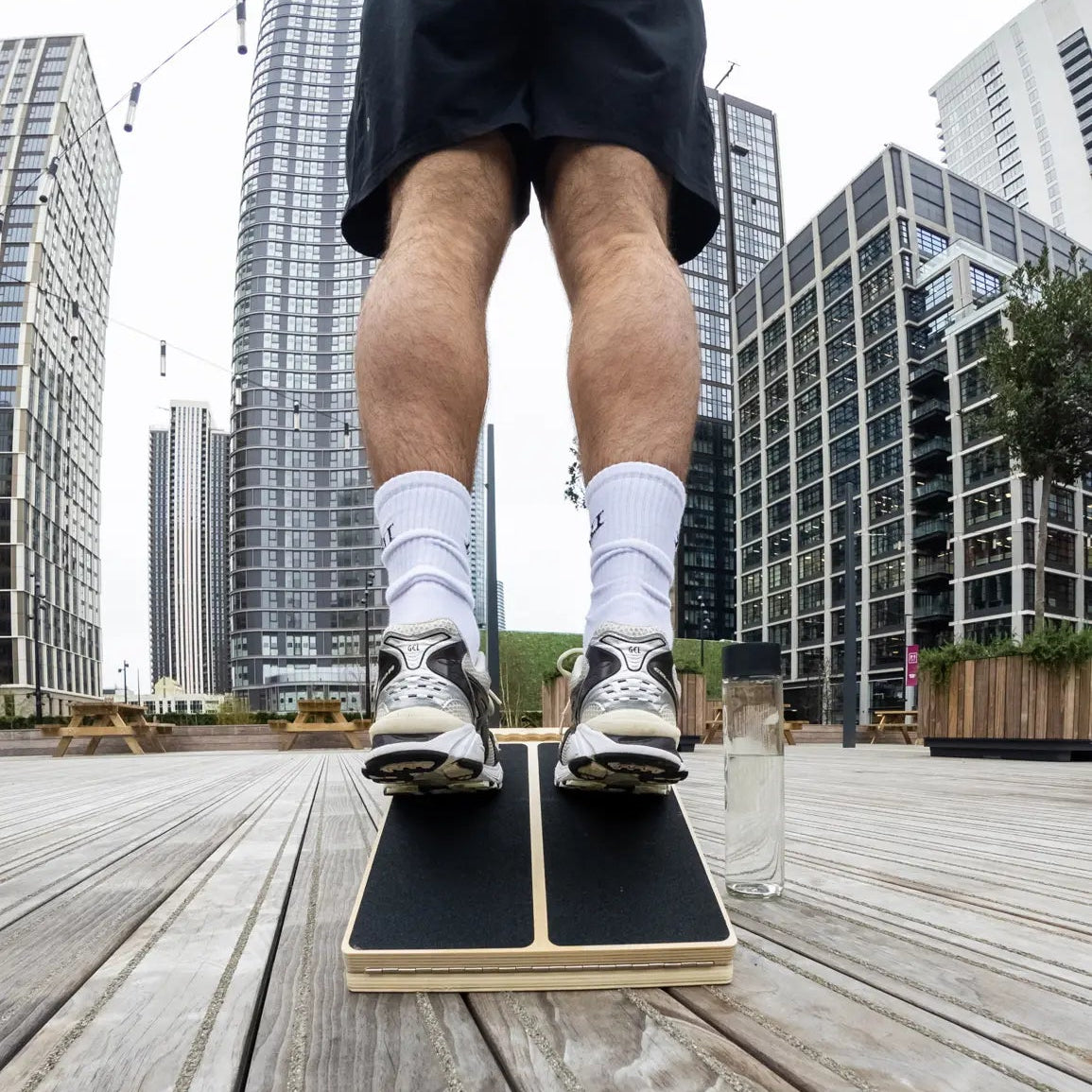

The problem nobody explains
Your insoles aren't broken. They're doing exactly what they were built to do.
That's why they stop working. They hold your arch up from underneath, so the small muscles that should be holding it up don't have to. Over months and years, those muscles get weaker. Every new pair of insoles starts you from a slightly weaker baseline than the last. The pain creeps back. You assume the insoles failed.
"I bought five pairs of insoles in four years. Every single pair felt amazing for about a month. I thought I was just unlucky."
You're not unlucky. The insole industry has built an entire category around external support — and external support, by definition, lets the muscles underneath get weaker. The fix is the opposite. The Aurayae Axis is built around a single principle: make the small foot muscles work again. Firm surface, one foot at a time, four minutes a day.
How it works
Four minutes a day. One foot at a time. The board changes as you do.
The Method
Built on the mechanism every other foot-pain product gets wrong.
Firm-surface, single-leg strengthening of the small foot stabilizers has been a core principle in physical therapy literature for decades. Insoles, supportive shoes, and orthotics work against this principle by design. The Aurayae Axis is built directly on it.
Why the BOSU on your floor stopped working.
Most balance tools and foot-pain products miss the same things. The Aurayae Axis was designed around what they leave out.

|
Others | |
|---|---|---|
| Firm surface (trains the foot, not the eyes) | ||
| Single-leg isolation | ||
| Adjustable configurations | ||
| Strengthens muscles, doesn't replace them | ||
| 60-day money-back guarantee |
What customers are saying
From people who'd already tried everything else.
Most of our customers are mid-40s and older. Most have had foot pain for years. Most had spent hundreds - sometimes thousands - on solutions that didn't last. Here's what they say once they've used the Axis for a few months.

Why we built this
There are a hundred companies selling supportive insoles. There aren't many selling the opposite.
The insole industry is a multi-billion-dollar category. Specialty foot-pain shoes, custom orthotics, gel inserts, podiatrist-prescribed devices - all built on the same principle: support the arch from underneath. Hold the foot up so the foot doesn't have to.
It works in the short term. That's why every new pair of insoles feels amazing for the first month. The pain drops, the support feels real, and you think you've finally found it.
Then somewhere around month two or three, the pain creeps back. You assume the insoles failed. You buy a new pair. The cycle starts over.
What's actually happening is that the small muscles holding your arch up - the ones that should be doing the work - have been doing less and less of it for as long as you've been wearing the support. They get weaker. Every new pair of insoles starts you from a slightly weaker baseline than the last.
The fix is the opposite of an insole. Make the small foot muscles work again. Firm surface, one foot at a time, four minutes a day. That's what the Aurayae Axis is. We didn't invent the mechanism - firm-surface single-leg training has been in physical therapy literature for decades. We just built the simplest version of the tool that the recovery stories kept pointing to.
If it doesn't change something for your feet in two months, send it back. That's the trade we're offering.

Included free with every order
The Foot Strengthening Field Guide. Free with every Axis.
A short, practical guide to using the Axis without overthinking it. Written for people who don't want a 90-minute morning routine, just enough structure to know what to do on day one, day fifteen, and day forty-five.
→ Day-one setup (which pegs, which bar, how long)
-------------------------------------------------------------
→ When to progress — the three signs your feet are ready for the next configuration
-------------------------------------------------------------
→ Common mistakes that slow your results (and the fixes)
-------------------------------------------------------------
→ How to integrate the Axis with barefoot shoes, toe spreaders, and other strengthening tools
-------------------------------------------------------------
→ When foot pain isn't a strength problem — three signs you should call your doctor instead
Questions
The honest answers.
I've already tried insoles, stretches, special shoes, PT, and a podiatrist. Why would this work when none of that did?
I've already tried insoles, stretches, special shoes, PT, and a podiatrist. Why would this work when none of that did?
Fair question. The short answer: every solution you listed works on the same principle - supporting the foot from outside or stretching the calf above it. None of them strengthen the small muscles inside the foot itself. That's the gap. The Axis isn't another support tool. It's the opposite - it forces those small muscles to do the work again. We back it with a 60-day money-back guarantee. If it doesn't change anything for you, you don't pay for it.
How long until I see results?
How long until I see results?
Most people notice the morning pain getting less sharp around week three. Walking down stairs gets easier around week six to eight. Standing barefoot for any length of time without pain typically takes two to three months. This is slower than the "feels amazing for a month" you may be used to with insoles - but it lasts.
How is this different from a BOSU ball or a regular wobble board?
How is this different from a BOSU ball or a regular wobble board?
Three things. First, the surface is firm, not soft - soft surfaces let your eyes and inner ear do the balancing instead of your feet. Second, it isolates one foot at a time - two-footed boards let your strong foot cover for the weak one, which is usually the one that needs the work. Third, it's adjustable across multiple configurations, so you can progress instead of plateauing on a fixed difficulty. Most BOSU balls and wobble boards miss all three.
Is this safe to use on my own?
Is this safe to use on my own?
Yes, for most people. The day-one setup is intentionally gentle - both feet on the floor, the board low to the ground, just enough movement to wake the muscles up. You progress from there as your feet get stronger. The Field Guide explains how to know when you're ready to advance. That said: if your foot pain is sharp, sudden, or recent (under six weeks), or if you've been told you have a stress fracture or torn fascia, please talk to a doctor before using anything that involves single-leg standing. The Axis is built for chronic foot pain that hasn't responded to other things - not for acute injuries.
What if it doesn't work for me?
What if it doesn't work for me?
You send it back within 60 days and we refund you. No restock fee, no questions, no "have you tried it for the full program?" hoop to jump through. We've been burned by enough product purchases ourselves to know that "60-day money-back" only counts if it's actually no-friction. Yours is.
I already wear barefoot shoes / use toe spreaders. Do I still need this?
I already wear barefoot shoes / use toe spreaders. Do I still need this?
This is a common question from the people who are already inside the strengthening framework. Honest answer: barefoot shoes and toe spreaders are passive - your feet strengthen because they have to do slightly more work than they were doing before. Active loading (single-leg, firm-surface, focused) does the same job faster. What takes a year of casual barefoot walking happens in 8-12 weeks of focused 4-minute sets. If you're patient and your feet are improving, you may not need this. If you want to accelerate the same process you're already on, this is the tool.
Stop buying insoles. Start strengthening the foot underneath.
The Aurayae Axis. Backed by a 60-day money-back guarantee. If it doesn't change your feet in two months, send it back.